Kinematics
Problem-solving process
01 / Problem-solving process
Problem-solving process
A complete process for a UAM problem
Before touching a calculator, how do you turn a written constant-acceleration problem into a solution whose equation, substitution, units, and physical meaning can all be checked?
Assumptions
- The motion is one-dimensional and acceleration is constant over the interval.
- A positive direction is declared before signed quantities are assigned.
- The immediately previous lesson introduced the UAM equations; this page practices selecting and using them rather than rebuilding the full equation inventory.
Read the complete problem
Read all the way through before attaching a number to a variable. A number near a word is not automatically the value of that quantity.
List the knowns and the requested unknown
t, , , , a
Write the five motion variables to keep track of what the problem gives, what its wording implies, and what it asks you to find.
Translate the words into variables
Phrases such as starts from rest, stops, muzzle velocity, and same direction reveal a zero value, a final value, or a sign relationship.
Select an equation
Choose a constant-acceleration relation containing the known quantities and the requested unknown. Let the available information choose the equation.
Rearrange before substituting when needed
Isolate the requested variable clearly. Showing that algebra makes the reasoning easier to inspect and reduces sign mistakes.
Substitute signed values with units
Carry signs and units into the substitution. The units help reveal whether the calculation can produce the requested kind of quantity.
Solve and check
Check the answer's units, direction, magnitude, and meaning in the original situation. A reference can support practice, but the goal is to recognize how the quantities fit together.
Result: Use this same read-list-select-rearrange-substitute-solve-check sequence in every example below. The visible reasoning is part of the solution, not decoration around a calculator result.
Check your understanding
What should be visible on your page before the first calculator entry?
Show the answer
The declared positive direction, the five motion variables, the signed knowns with units, the target, and the selected equation.
A calculator can evaluate an expression, but it cannot decide whether the model, signs, or equation match the physical situation.
02 / Starting and stopping
Starting and stopping
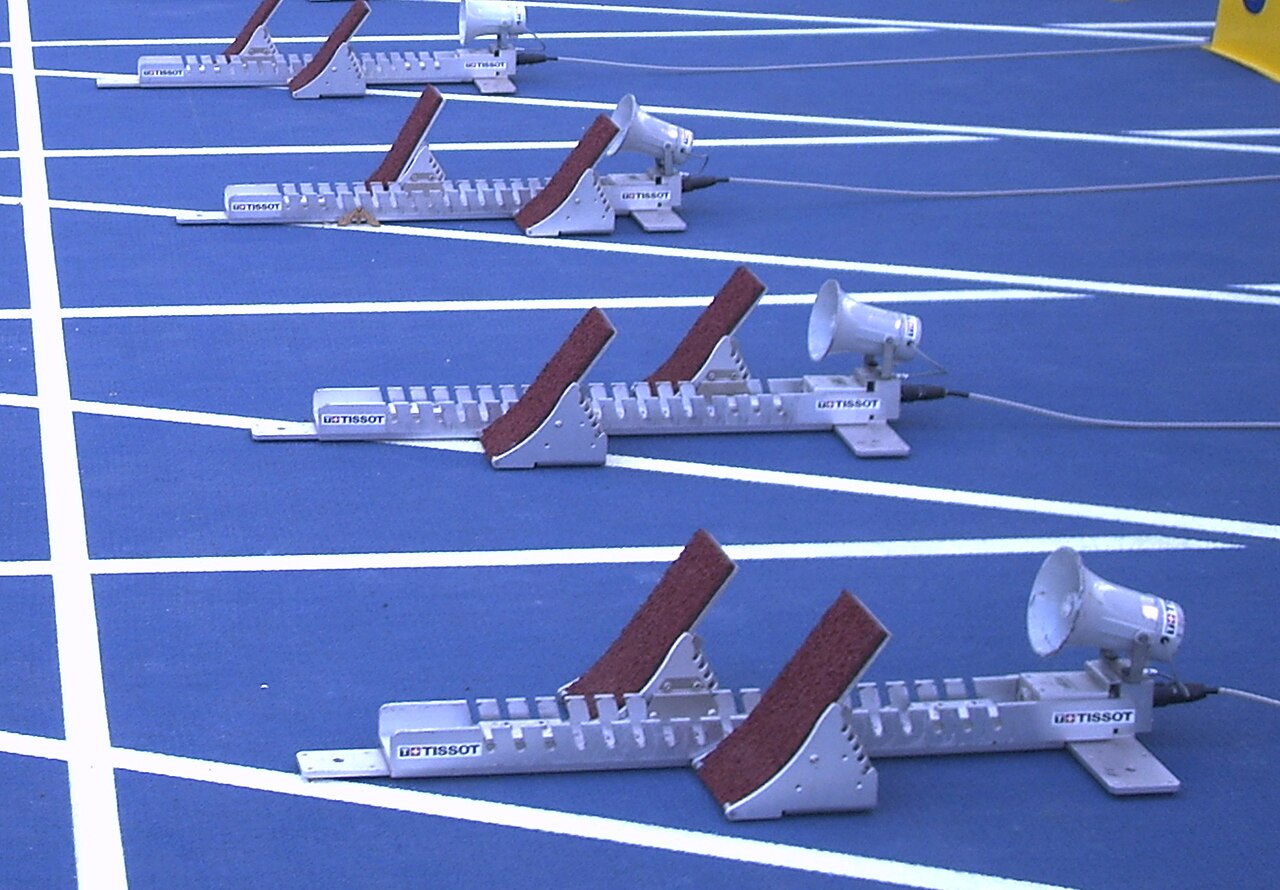
Example 1: A sprinter starting a race
An Olympic-class sprinter starts a race with an acceleration of 4.5 m/s². Find her speed 2.4 s later.
Assumptions
- Acceleration is constant during the 2.4 s interval.
- Take the sprinter's motion as the positive direction.
- Starting the race means the initial velocity is zero in this model.
Read and translate the wording
a = +4.5 m/s²; t = 2.4 s; = 0 m/s
The number 2.4 is elapsed time, even though it appears near the requested word speed. Starts a race supplies the hidden known = 0.
Name the unknown
=?
In this positive-direction setup, the requested final speed is the magnitude of the final velocity.
Select the equation
=+at
This relation contains the three known quantities and the requested final velocity.
Substitute with units
= 0 m/s + (4.5 m/s²)(2.4 s)
Seconds cancel one power of seconds in the acceleration unit, leaving meters per second.
Solve and check
= 10.8 m/s
Positive acceleration from rest produces a positive final velocity. The sign and unit fit the chosen positive direction and the requested speed. The printed givens each have two significant figures, so 11 m/s is the corresponding strict final rounding.
Result: The calculated speed is 10.8 m/s after 2.4 s. If the final answer must match the two significant figures in the givens, report 11 m/s.
Check your understanding
Which phrases in motion problems commonly provide a zero velocity without printing the number 0?
Show the answer
Starts from rest gives = 0, while stops or comes to rest gives = 0.
Translate the wording before selecting an equation. Implied values are still known quantities.

Example 2: A ball stopping in a mitt
A well-thrown ball is caught in a well-padded mitt. Its deceleration magnitude is 2.10 × 10⁴ m/s², and it stops during 1.85 × 10⁻³ s. Find its initial velocity.
Assumptions
- Acceleration is constant during the short stopping interval.
- Take the ball's initial forward direction as positive.
- The ball stops in the mitt, so its final velocity is zero.
Draw the direction model in words
> 0; a < 0; = 0
Initial velocity points in the declared positive forward direction. The mitt's acceleration points opposite that direction, so it is negative. The final velocity is zero. These labels communicate the directions without relying on color.
List the knowns
a = −2.10 × 10⁴ m/s²; t = 1.85 × 10⁻³ s; = 0 m/s
The everyday word deceleration does not supply a universal negative sign. The sign comes from the declared positive direction and the fact that the acceleration points opposite it.
Select and rearrange
= + at; 0 = + at; = −at
The final-velocity equation contains all three knowns and the initial velocity. Isolate before inserting the signed values.
Substitute
= −(−2.10 × 10⁴ m/s²)(1.85 × 10⁻³ s)
The minus sign from the rearrangement and the negative acceleration cancel. That agrees with an initial velocity in the positive direction.
Solve and check
= 38.85 m/s
The unrounded result is 38.85 m/s in the positive direction. With three significant figures in the printed data, 38.9 m/s is an appropriate final result.
Result: The ball's initial velocity is positive 38.85 m/s before final rounding, or positive 38.9 m/s to three significant figures. Negative acceleration here means acceleration in the negative chosen direction; it is not a rule that negative acceleration always slows an object.
03 / Changing velocity
Changing velocity
Example 3: A bullet moving through a barrel
A bullet accelerates from the firing chamber to the end of the barrel at 6.20 × 10⁵ m/s² for 8.10 × 10⁻⁴ s. Find its muzzle velocity.
Assumptions
- Acceleration is constant while the bullet moves through the barrel.
- Take the motion through the barrel as positive.
- The source model treats the bullet's initial velocity as zero.
Translate muzzle velocity
=?
Muzzle velocity means the velocity as the bullet leaves the barrel, so it is the final velocity for this interval.
List the knowns
a = +6.20 × 10⁵ m/s²; t = 8.10 × 10⁻⁴ s; = 0 m/s
The positive sign follows the declared direction, and the source model begins from rest.
Select and simplify
=+at=at
The same final-velocity relation used in the sprinter example applies, and the initial-velocity term is zero.
Substitute and solve
= (6.20 × 10⁵ m/s²)(8.10 × 10⁻⁴ s) = 502.2 m/s
The time unit removes one power of seconds from acceleration, leaving velocity units.
Result: The unrounded result is 502.2 m/s in the positive direction. The given values have three significant figures, so 502 m/s, or 5.02 × 10² m/s, is a suitable final result.
04 / Two requested results
Two requested results
Example 4: Entering a freeway
A car accelerates from rest at 2.40 m/s² for 12.0 s. Find its displacement and final velocity.
Assumptions
- Acceleration is constant during the 12.0 s interval.
- Take the car's motion as positive.
- From rest means the initial velocity is zero.
List the knowns and both unknowns
= 0 m/s; a = +2.40 m/s²; t = 12.0 s; = ?; = ?
One set of original givens can answer both parts. Treat displacement and final velocity as separate targets.
Select the displacement equation
= t + ½at²
This equation contains the initial velocity, acceleration, and time while omitting the still-unknown final velocity.
Use the zero initial velocity
= ½(2.40 m/s²)(12.0 s)² = 172.8 m
The t term is zero. Square the time value only; do not square the whole substituted expression. The unrounded result is 172.8 m, which is 173 m to three significant figures.
Return to the original givens for final velocity
= + at = 0 + (2.40 m/s²)(12.0 s) = 28.8 m/s
This independent path avoids using the calculated displacement, so an arithmetic mistake in the first part would not automatically carry into the second.
Check both units
(m/s²)(s²) = m; (m/s²)(s) = m/s
The first calculation produces displacement units, and the second produces velocity units.
Result: The car's displacement is 172.8 m before final rounding, and its final velocity is positive 28.8 m/s. Report the displacement as 173 m to three significant figures.
AP Focus: earn the reasoning points, not only the number
Show the sign convention, identify the relevant interval, and connect each given value to a variable before substituting.
Write the equation in symbols before inserting numbers. Carry units through the calculation and interpret the sign of a vector answer in words.
When a problem has multiple parts, return to the original givens when possible. An independent solution path reduces the chance that one arithmetic error will contaminate every later result.
Check your understanding
In the freeway-car example, why is it better to find final velocity from the original givens instead of using the calculated displacement?
Show the answer
It creates an independent path, so a displacement arithmetic error does not automatically carry into the velocity result.
The same physical information can support more than one valid equation path. Independence is useful for both solving and checking.
05 / Choosing a different equation
Choosing a different equation
Example 5: A hockey puck during a slap shot
A puck changes velocity from 8.00 m/s to 40.0 m/s in the same direction during 3.33 × 10⁻² s. Find the displacement over which it accelerates.
Assumptions
- Acceleration is constant during stick-puck contact.
- Take the shared direction of the initial and final velocities as positive.
- The requested displacement covers only the contact interval.
List the endpoint velocities and time
= +8.00 m/s; = +40.0 m/s; t = 3.33 × 10⁻² s
Both velocities are positive because the problem states that they point in the same direction.
Select the easiest route
v̄ = ( + ) ÷ 2
For constant acceleration, the average velocity over the interval is the arithmetic mean of the endpoint velocities. Neither endpoint alone is the average, and delta does not mean average.
Find the average velocity
v̄ = (8.00 m/s + 40.0 m/s) ÷ 2 = 24.0 m/s
The endpoint average is valid because acceleration is constant over the interval.
Use average velocity to find displacement
= v̄t = (24.0 m/s)(3.33 × 10⁻² s) = 0.7992 m
The calculator value is 0.7992 m. To three significant figures, the result is 0.799 m; approximately 0.80 m communicates the scale.
Limit the meaning of the result
≈ 0.80 m
The approximately 0.80 m interval runs from the beginning to the end of stick-puck contact. It is not the puck's entire travel after the shot.
Result: The puck moves 0.7992 m during contact, approximately 0.80 m. Finding acceleration first and then displacement is also valid, but the constant-acceleration average-velocity route is the most direct here.
Check your understanding
Does the 0.80 m result describe the puck's entire trip after the slap shot?
Show the answer
No. It describes only the displacement during the stick-puck contact interval in the model.
A correct number can still be misinterpreted if the interval is not stated.
Example 6: A motorcycle accelerating from rest
A motorcycle accelerates from rest to 26.8 m/s in 3.90 s. Find its average acceleration and displacement.
Assumptions
- Acceleration is constant during the 3.90 s interval.
- Take the motorcycle's motion as positive.
- From rest means the initial velocity is zero.
List the knowns and targets
= 0 m/s; = 26.8 m/s; t = 3.90 s; a = ?; = ?
The source asks for acceleration first and then displacement.
Find acceleration
a = ( − ) ÷ t = (26.8 m/s − 0) ÷ 3.90 s = 6.87 m/s²
The verified lesson board shows 6.87 m/s², resolving an inaccurate automatic-caption rendering of the number.
Choose a displacement path
² = ² + 2a
The no-time equation is used after finding acceleration. The endpoint-average route or the displacement-time equation would also be valid.
Rearrange with the whole denominator grouped
= (² − ²) ÷ (2a) = ² ÷ (2a)
The initial velocity is zero. Keep 2a together in the denominator rather than dividing by 2 and then multiplying by a.
Substitute and check
= (26.8 m/s)² ÷ [2(6.87 m/s²)] ≈ 52.27 m
Squared velocity divided by acceleration produces meters. The result rounds to 52.3 m to three significant figures.
Result: The source-backed values are 6.87 m/s² and approximately 52.27 m in the positive-direction setup. Report the displacement as 52.3 m to three significant figures.
06 / Final challenge
Final challenge
Example 7: A fireworks shell
A fireworks shell accelerates from rest to 65.0 m/s over 0.250 m. Find how long the acceleration lasts and the acceleration.
Assumptions
- Acceleration is constant over the 0.250 m interval.
- Take the shell's motion as positive.
- From rest means the initial velocity is zero.
List the givens and targets
= 0 m/s; = 65.0 m/s; = 0.250 m; t = ?; a = ?
The problem asks for time first, but none of the three given values is time. Equation choice should follow the givens, not the printed order of the questions.
Choose the no-time equation first
² = ² + 2a
This relation contains all three givens and acceleration while omitting time.
Rearrange and find acceleration
a = (² − ²) ÷ (2) = (65.0 m/s)² ÷ [2(0.250 m)] = 8450 m/s²
With = 0, the initial-velocity term disappears. The board-confirmed result is 8,450 m/s², equivalently 8.45 × 10³ m/s².
Use acceleration to find time
a = ÷ t; t = ÷ a = 65.0 m/s ÷ 8450 m/s²
The velocity change is 65.0 m/s because the shell starts from rest.
Solve and verify the exponent
t = 0.00769 s = 7.69 × 10⁻³ s
The decimal result and the board arithmetic require an exponent of negative three. A caption or spoken rendering of negative four conflicts with the verified calculation and is not used.
Result: The acceleration is 8,450 m/s², and it lasts 0.00769 s, or 7.69 × 10⁻³ s. Acceleration is found first because the no-time equation matches the givens directly.
Check your understanding
What should you carry from these seven examples into the next constant-acceleration problem?
Show the answer
Read the whole problem, list the motion variables, translate words into values and signs, choose an equation from the knowns and target, rearrange, substitute with units, solve, and check the answer in the original situation.
Starts from rest means = 0, stops means = 0, and a named direction or same-direction statement helps assign signs. A sign convention determines whether acceleration is positive or negative. More than one valid equation path may exist, and an independent path from the original givens can prevent one arithmetic error from spreading. Always check units, direction, magnitude, and what interval the result actually describes.
Continue the sequence
Continue learning
This page follows the Uniform Accelerated Motion examples lesson in the Kinematics course sequence.
See the Kinematics course