Kinematics
When UAM applies
01 / When UAM applies
When UAM applies
When the UAM equations apply
Uniform accelerated motion, or UAM, is one-dimensional motion with an acceleration that stays constant during the interval being studied. Constant means not changing; the constant value may be nonzero or exactly zero.
Check that condition before choosing an equation. If acceleration changes during the interval, this equation set does not describe the entire motion as one UAM interval.
Check your understanding
Does motion with a = 0 qualify as uniform accelerated motion?
Show the answer
Yes. Zero is a constant value, so constant-velocity motion is the a = 0 case of the UAM model.
The condition is constant acceleration, not necessarily nonzero acceleration.
Scroll horizontally to view every column.
| Relationship | Readable form | What it describes |
|---|---|---|
| Average velocity | v̄ = ÷ t | Signed displacement divided by elapsed time |
| Acceleration | a = ÷ t | Change in velocity divided by elapsed time |
02 / Average velocity
Average velocity
Two views of average velocity
For a constant-acceleration interval, the endpoint velocities are 10 m/s and 20 m/s. What is the average velocity?
Assumptions
- Acceleration is constant over the interval.
- Both velocities are signed values measured along the same one-dimensional axis.
- The listed velocities are the initial and final values for the interval.
Use the interval definition
v̄ = ÷ t
Average velocity always describes signed displacement per elapsed time for the entire interval.
Use the endpoint form for constant acceleration
v̄ = ( + ) ÷ 2
Only when acceleration is constant does the time-average velocity equal the arithmetic mean of the initial and final velocities.
Substitute the endpoint values
v̄ = (10 m/s + 20 m/s) ÷ 2 = 15 m/s
Add the two signed endpoint velocities and divide by two.
Result: The average velocity is 15 m/s for this constant-acceleration interval.
Check your understanding
Why can you not automatically use v̄ = ( + ) ÷ 2 for motion with changing acceleration?
Show the answer
With changing acceleration, velocity does not necessarily change evenly with time, so the two endpoint velocities may not represent the time average.
The arithmetic endpoint mean is a UAM relationship, not a universal definition of average velocity.
03 / Build the equations
Build the equations
Build the final-velocity equation
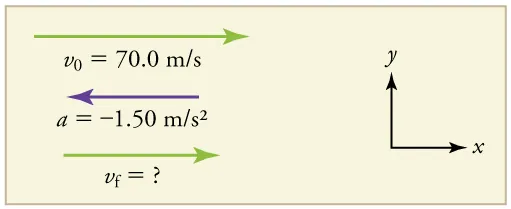
Start with the acceleration equation, replace change in velocity with final minus initial velocity, and isolate final velocity.
Assumptions
- Acceleration is constant.
- The positive direction has been declared.
- Initial velocity, final velocity, and acceleration carry signs from the same coordinate system.
- Elapsed time is positive.
Expand change in velocity
a = ( − ) ÷ t
Change in velocity means final velocity minus initial velocity.
Multiply both sides by time
at = −
Multiplying by t removes the denominator.
Add the initial velocity
= + at
This form gives final velocity when initial velocity, acceleration, and elapsed time are known.
Result: The final velocity is the initial velocity plus the signed velocity change at.
Scroll horizontally to view every column.
| Equation | What to notice | Condition |
|---|---|---|
| = t + ½at² | Finds displacement without using final velocity. | Acceleration remains constant over the interval. |
| ² = ² + 2a | Relates velocities, acceleration, and displacement without using time. | Acceleration remains constant over the interval. |
04 / Choose an equation
Choose an equation
Scroll horizontally to view every column.
| Core UAM equation | t | a | |||
|---|---|---|---|---|---|
| = ½( + )t | Used | Used | Used | Used | Omitted |
| = + at | Used | Omitted | Used | Used | Used |
| = t + ½at² | Used | Used | Used | Omitted | Used |
| ² = ² + 2a | Omitted | Used | Used | Used | Used |
Keep the motion symbols distinct
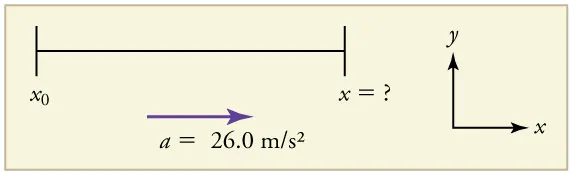
Signed displacement is = final position − initial position. The same relationship may be written as − .
An overline over v means average velocity, while means change in velocity. They are different quantities and are not interchangeable.
Elapsed time t is the positive duration of the interval. Displacement, velocity, and acceleration receive signs from the chosen positive direction.
AP Focus: choose by quantities, not by appearance
Before substituting numbers, define the positive direction and write t, , , , and a with units and signs.
Select an equation that contains the known quantities and the target while omitting the unused variable. The no-time equation is especially important when time is neither known nor needed.
After solving, check units, sign, dimensions, and whether the result matches the described motion. Squared velocity can hide direction, so a square-root result must be interpreted in context.
Check your understanding
A problem gives , , and a, asks for displacement, and gives no time. Which equation fits directly?
Show the answer
Use ² = ² + 2a.
It contains both velocities, acceleration, and displacement while omitting time.
05 / Signs and zero acceleration
Signs and zero acceleration
Let the sign of acceleration do its job
Substitute a negative acceleration with its negative sign. If velocity is positive while acceleration is negative, the acceleration term reduces the positive-direction result. Negative acceleration does not always mean slowing down; the effect depends on the velocity direction.
Setting a = 0 checks the model. The displacement equation becomes = t, and the final-velocity equation becomes = . The UAM equations reduce to constant-velocity motion exactly as they should.
Check your understanding
Set a = 0 in = + at. What physical result should the equation give?
Show the answer
It becomes = , so velocity remains constant.
A useful equation should reduce to the correct simpler model when the relevant quantity becomes zero.
06 / Selection practice
Selection practice
List the variables, choose the equation, then solve
How should you organize a well-posed one-dimensional constant-acceleration problem when three independent motion quantities are known and another is the target?
Assumptions
- The motion is one-dimensional.
- Acceleration is constant over the interval.
- The given quantities are independent and physically consistent.
- A positive direction has been declared or can be inferred from the problem.
Confirm the model
a = constant
Use the UAM set only when acceleration stays constant over the interval.
Write all five variables
t, , , , a
List the five quantities before choosing an equation.
Mark the knowns and target
Record each known value with its sign and unit, and identify the requested quantity.
Choose the equation that fits
Use the matrix to find an equation containing the knowns and target while omitting the unused variable.
Substitute and solve
Insert signed values with units, carry out the algebra, and isolate the requested quantity.
Check the result
Check units, sign, dimensions, limiting behavior, and physical reasonableness.
Result: The equation list becomes manageable when the five variables are organized first. The three-knowns approach applies to a well-posed UAM problem with three independent quantities; an arbitrary set of three numbers does not automatically guarantee one unique physical solution.
Check your understanding
A car starts with = 6 m/s, accelerates at 2 m/s² for 4 s, and you want its displacement. Which core equation is the direct choice, and which variable does it omit?
Show the answer
Use = t + ½at². It uses , , t, and a while omitting .
Choose the equation from the variables before doing arithmetic. The numerical solution belongs in the following examples lesson.
Continue the sequence
Continue learning
This page follows the Uniform Accelerated Motion equations lesson in the Kinematics course sequence.
See the Kinematics course