Kinematics
What acceleration means
01 / What acceleration means
What acceleration means
Acceleration does not mean velocity. An object can move very fast with little or no acceleration, and an object can have a large acceleration while its speed is small.
Everyday speech sometimes uses “high acceleration” when the intended idea is “high speed.” In physics, keep the quantities separate before choosing an equation.
Rate of change means change divided by time
For any rate, identify what changes and divide that change by the elapsed time. For acceleration, the changing quantity is velocity.
Because velocity is a vector, it can change when its magnitude changes, when its direction changes, or when both change.
Scroll horizontally to view every column.
| Relationship | Meaning | SI unit |
|---|---|---|
| average acceleration = change in velocity ÷ elapsed time | How quickly velocity changes during the interval | m/s² |
| change in velocity = final velocity − initial velocity | A signed or vector change, not simply a change in speed | m/s |
Scroll horizontally to view every column.
| Car | 0 s | 1 s | 2 s | 3 s | 4 s | 5 s |
|---|---|---|---|---|---|---|
| A | 70 m/s | 72 m/s | 74 m/s | 76 m/s | 78 m/s | 80 m/s |
| B | 0 m/s | 3 m/s | 6 m/s | 9 m/s | 12 m/s | 15 m/s |
| C | 90 m/s | 90 m/s | 90 m/s | 90 m/s | 90 m/s | 90 m/s |
| D | 100 m/s | 99 m/s | 98 m/s | 97 m/s | 96 m/s | 95 m/s |
Check your understanding
Treat the listed direction as positive. Rank the four cars' accelerations from smallest to greatest, and state each acceleration.
Show the answer
D, C, A, B. Their accelerations are −1 m/s², 0 m/s², +2 m/s², and +3 m/s², respectively.
Compare equal one-second intervals. Car D's velocity decreases by 1 m/s each second, Car C's velocity does not change, Car A gains 2 m/s each second, and Car B gains 3 m/s each second. A large velocity does not necessarily mean a large acceleration.
Check your understanding
A spacecraft moves at a constant velocity of 2,000 m/s in a straight line. Another spacecraft is momentarily at rest while its engines produce a nonzero acceleration. Which has the greater speed, and which is accelerating?
Show the answer
The first spacecraft has the greater speed. The second is accelerating, while the first has zero acceleration because its velocity is constant.
Speed describes how fast an object is moving. Acceleration describes how velocity changes. A large speed does not require a large acceleration, and a zero speed at one instant does not require zero acceleration.
02 / Signs and speed
Signs and speed
Positive does not automatically mean speeding up
A positive acceleration points in the direction chosen as positive. A negative acceleration points in the opposite direction. The sign describes direction; by itself, it does not tell you whether speed increases or decreases.
That is why positive acceleration does not always mean speeding up, and negative acceleration does not always mean slowing down.
Scroll horizontally to view every column.
| Often chosen positive | Often chosen negative | Important caution |
|---|---|---|
| Up | Down | A problem may choose the opposite convention. |
| Right | Left | State or read the chosen positive direction. |
| North or east | South or west | Cardinal directions still form opposite pairs. |
| Positive x, y, or z | Negative x, y, or z | The axis signs encode direction. |
| Forward or in | Backward or out | Use the pair defined for the situation. |
Why the standard unit is meters per second squared
Acceleration divides a change in velocity by time. A velocity measured in meters per second divided by seconds gives meters per second per second, written m/s².
Other acceleration units are possible whenever a velocity unit is divided by a time unit, but the standard SI unit is the meter per second squared.
03 / Three stages of motion
Three stages of motion
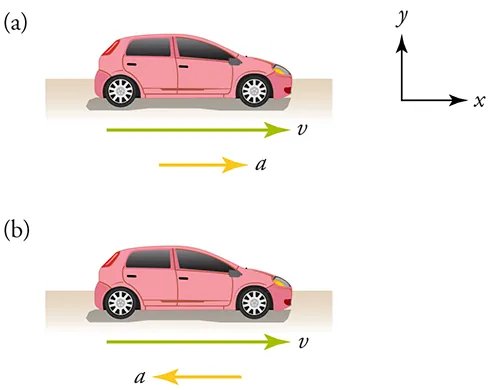
One rightward acceleration can produce three stages of motion
Choose right as positive and keep the acceleration constant and rightward. An object that starts from rest develops an increasing rightward velocity, so it speeds up.
Now let the object begin by moving left while the acceleration still points right. Its leftward velocity becomes smaller, reaches zero, and then becomes rightward. Before the stop, velocity and acceleration point in opposite directions, so speed decreases. After the reversal, they point in the same direction, so speed increases.
A stretched bungee cord could pull an object toward the right, but a real bungee would generally not provide constant acceleration. The simplified example is about direction, stopping, and reversal—not a complete bungee model.
Check your understanding
At the instant the left-moving object stops before reversing to the right, its velocity is zero. Must its acceleration also be zero?
Show the answer
No. Its velocity can be zero at that instant while the acceleration still points right.
Zero velocity describes one instant. A nonzero rightward acceleration continues changing the velocity, so the object begins moving right immediately after the turnaround.
Scroll horizontally to view every column.
| Velocity | Acceleration | Speed |
|---|---|---|
| Positive | Positive | Increases |
| Positive | Negative | Decreases |
| Negative | Positive | Decreases |
| Negative | Negative | Increases |
AP Physics Focus: reason with direction before using a sign
State or identify the positive direction before interpreting a positive or negative velocity or acceleration. The sign is a compact direction label, not a synonym for speeding up or slowing down.
A strong response compares the velocity and acceleration directions explicitly: same direction means increasing speed, while opposite directions mean decreasing speed. At a turnaround, velocity can be zero while acceleration remains nonzero.
04 / Uniform acceleration
Uniform acceleration
Uniform accelerated motion includes zero acceleration
Uniform accelerated motion, or UAM, means the acceleration remains constant during the modeled interval.
The constant value can be nonzero, such as 2 m/s² throughout an interval, or it can be exactly zero. Zero acceleration that stays zero is still constant acceleration.
05 / Changing direction
Changing direction
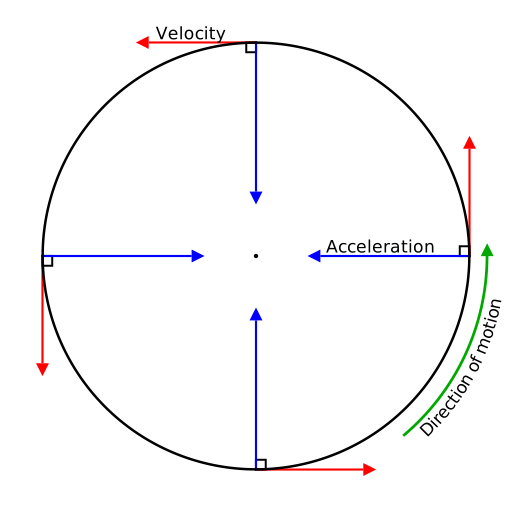
Looking ahead: acceleration can change direction without changing speed
Velocity has magnitude and direction. If an object's speed stays the same while its direction changes, its velocity changes, so the object accelerates.
In uniform circular motion, the velocity is tangent to the path while an inward acceleration continually changes its direction. The detailed cause of that acceleration belongs to later dynamics and circular-motion lessons.
Check your understanding
Right is positive. A cart is moving left while its acceleration points right. Is the acceleration positive or negative, and is the cart speeding up or slowing down at that moment?
Show the answer
The acceleration is positive, and the cart is slowing down.
The acceleration points right, the chosen positive direction. The velocity points left, opposite the acceleration, so the cart's speed decreases until it reaches zero or the acceleration changes.
06 / Practice
Practice
Check your understanding
Right is positive. A cart has velocity −8 m/s and acceleration −2 m/s². Without calculating a future velocity, determine the cart's direction of motion and whether its speed is increasing or decreasing.
Show the answer
The cart moves left and its speed is increasing.
Both velocity and acceleration are negative, so both vectors point left. Because they point in the same direction, the magnitude of the velocity increases.
Continue the sequence
Continue learning
This page follows the acceleration lesson in the Kinematics course sequence.
See the Kinematics course