Kinematics
Speed and velocity
01 / Speed and velocity
Speed and velocity
The difference between speed and velocity follows the same pattern as the difference between distance and displacement: one is scalar, and the other is vector.
Speed tells you how fast an object moves. Velocity tells you how fast it moves and in what direction.
Scroll horizontally to view every column.
| Feature | Speed | Velocity |
|---|---|---|
| Quantity type | Scalar | Vector |
| Direction required | No | Yes for a nonzero velocity |
| What the value communicates | How fast | How fast and in which direction |
| Average value uses | Total distance | Displacement |
Check your understanding
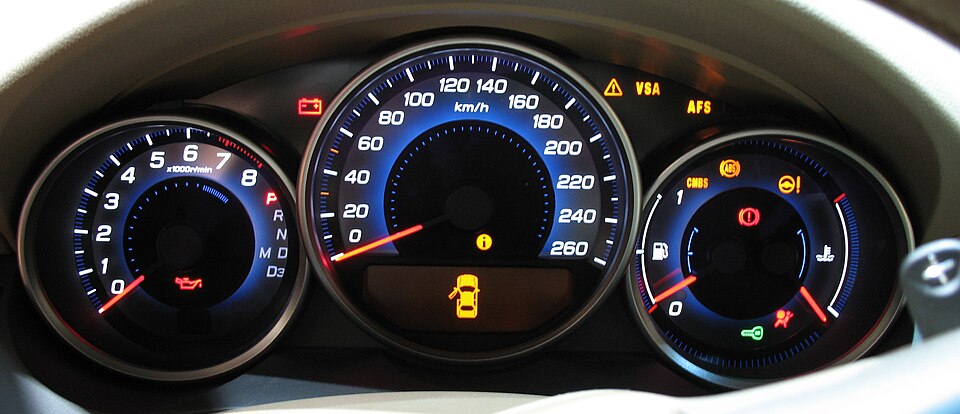
A car's speedometer reads 18 m/s. Does that reading give the car's instantaneous speed, instantaneous velocity, or both?
Show the answer
It gives the instantaneous speed only.
The reading tells how fast the car is moving at that moment. Instantaneous velocity would also require the direction of travel.
02 / Average and instantaneous
Average and instantaneous
Average describes the whole interval; instantaneous describes one moment
A car may begin at 10 meters per second, increase to 20 meters per second, stop, and change speed again. One average value summarizes the entire time interval even though the motion changes within it.
An instantaneous value describes one particular moment. A speedometer reading at a given instant can be different from the average speed for the whole trip.
Notation that changes the meaning
The symbol v is commonly used for speed and velocity. Context determines whether the quantity is scalar or vector; the letter alone does not settle the distinction.
A bar over the symbol indicates an average value: v̄. The bar is not decorative or optional when the notation is intended to distinguish an interval average from an instantaneous value.
Check your understanding
Two answers are both written as 12 m/s. One is marked v and the other v̄. What distinction does the bar communicate?
Show the answer
The barred symbol represents an average over a time interval; the unbarred symbol can represent a value at a particular instant or another specifically labeled value.
The numbers and units can match while the physical meanings differ. Read the notation and the interval described by the problem.
03 / Rate relationships
Rate relationships
Scroll horizontally to view every column.
| Quantity | Relationship | SI unit |
|---|---|---|
| Average speed | total distance ÷ elapsed time | m/s |
| Average velocity | displacement ÷ elapsed time | m/s |
Choose the numerator that matches the question
Average speed uses the full distance traveled. Average velocity uses the displacement from the initial position to the final position.
Both results use meters per second when the motion is measured in meters and seconds, so the unit alone cannot tell you whether the result is speed or velocity. You must interpret the quantity and include a direction or signed axis convention for a nonzero velocity.
04 / One-lap example
One-lap example
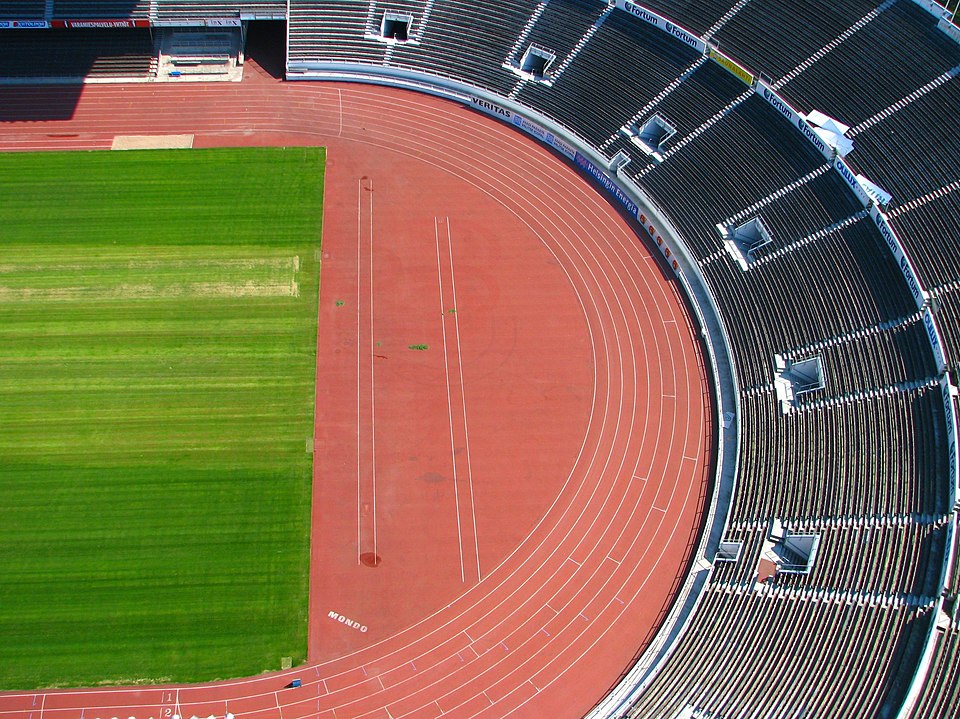
One lap around a 400-meter track
A runner completes one 400-meter lap in 60 seconds and finishes at the starting point. Find the average speed and average velocity for the lap.
Assumptions
- The track length is 400 meters.
- The measured interval is exactly 60 seconds.
- The runner's final position is the initial position.
Find the average speed
average speed = 400 m ÷ 60 s ≈ 6.67 m/s
Average speed uses the total distance. Direction is not part of this scalar answer.
Find the displacement
displacement = 0 m
The runner finishes at the starting point, so the change in position is zero.
Find the average velocity
average velocity = 0 m ÷ 60 s = 0 m/s
Average velocity uses displacement, so it is zero even though the runner moved throughout the lap.
Result: The average speed is approximately 6.67 meters per second. The average velocity is 0 meters per second.
05 / AP Physics focus
AP Physics focus
AP Physics Focus: name the quantity before calculating
For average speed, use total distance. For average velocity, use displacement and communicate the direction of any nonzero result with a sign tied to a stated axis, a named direction, or an equivalent vector representation.
A speedometer reading is instantaneous speed, not a complete instantaneous velocity. On an assessment, the missing direction matters even if casual conversation sometimes uses speed and velocity loosely.
Check your understanding
Over the same time interval, can the magnitude of an object's average velocity be greater than its average speed? Explain without relying on a memorized rule.
Show the answer
No. The magnitude of average velocity cannot exceed average speed for the same interval.
The displacement magnitude is the straight-line change from start to finish, while distance includes the path traveled and is never smaller than that straight-line change. Dividing both by the same positive elapsed time preserves the comparison.
Check your understanding
A student travels 100 meters east and then 100 meters west, returning to the starting point in 40 seconds. What are the average speed and average velocity?
Show the answer
The average speed is 5 meters per second. The average velocity is 0 meters per second.
The total distance is 200 meters, so average speed is 200 meters divided by 40 seconds. The displacement is zero because the final and initial positions are the same.
06 / Practice
Practice
Check your understanding
A cyclist rides 300 m east in 50 s and then 100 m west in 20 s. Find the average speed and the average velocity for the entire trip. Use east as positive and explain why the two averages differ.
Show the answer
The average speed is 400 m ÷ 70 s ≈ 5.71 m/s. The displacement is +200 m, so the average velocity is +200 m ÷ 70 s ≈ +2.86 m/s, or 2.86 m/s east.
Average speed uses the total path length, 300 m + 100 m. Average velocity uses the net change in position, +300 m − 100 m. Reversing direction adds to distance but reduces the eastward displacement.
Continue the sequence
Continue learning
This page follows the speed and velocity lesson in the Kinematics course.
See the Kinematics course