Kinematics
Scalars
01 / Scalars
Scalars
Physics depends on describing quantities precisely. Two terms that sound abstract at first—scalar and vector—give us the basic distinction: a scalar needs a value but no spatial direction, while a vector needs both a magnitude and a direction.
A useful introductory shorthand is “magnitude only” for a scalar and “magnitude and direction” for a vector. This distinction keeps returning as you study mass, time, force, velocity, acceleration, momentum, and other quantities.
Scroll horizontally to view every column.
| Scalar quantity | What its value tells you |
|---|---|
| Mass | How much mass an object has |
| Temperature | How hot or cold something is on the chosen scale |
| Time | How much time passes |
| Distance | How much path length is traveled |
| Speed | How fast an object moves |
| Energy | How much energy is present or transferred |
A scalar has a value but no spatial direction
Suppose an object has a mass of 2 kilograms. “2 kilograms” is enough information; the mass is not 2 kilograms left or right. The same idea works for a temperature of 22 degrees Celsius: the value is complete without a direction.
A scalar value can be positive, zero, or negative. A negative temperature is still a scalar because it does not point north, south, left, or right.
02 / Vectors
Vectors
A vector has magnitude and direction
Imagine that someone tells you to drive at 65 miles per hour for two hours. That gives you a speed and a time, but not a destination. If the velocity stays constant, traveling north, south, east, or west at the same speed for the same time leaves you in different places. A complete velocity instruction includes direction, such as 65 miles per hour north.
Displacement, velocity, force, acceleration, momentum, and weight are vector quantities. In each case, direction is part of the physical meaning.
Check your understanding
A weather report gives a temperature of −6 °C, and a navigation instruction gives a velocity of 20 m/s. Which description is already complete, and what information is missing from the other?
Show the answer
The temperature is complete as a scalar value. The velocity is incomplete because it needs a direction.
A negative number does not automatically make a quantity a vector. Temperature can be negative without pointing anywhere. Velocity requires both magnitude and direction, so 20 m/s alone describes only the magnitude.
03 / Distance and displacement
Distance and displacement
Distance and displacement are not interchangeable
In everyday conversation, people often use distance and displacement as if they mean the same thing. In physics, they answer different questions.
Scroll horizontally to view every column.
| Feature | Distance | Displacement |
|---|---|---|
| Quantity type | Scalar | Vector |
| What it tells you | How far the object moved along its path | The change in position from start to finish |
| Direction | Not required | Required unless the displacement is zero |
| What it depends on | The path traveled | Only the starting and final positions |
| After returning to the start | Greater than zero if a path was traveled | Zero |
Check your understanding
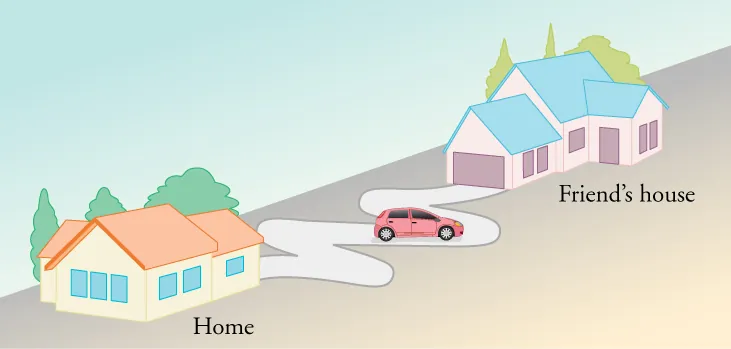
Two students leave the same doorway and finish at the same bench. One follows a winding sidewalk while the other walks along a straight path. Compare their distances and displacements.
Show the answer
Their distances can be different, but their displacements are the same.
Distance depends on the path traveled. Displacement depends only on the shared starting and final positions, including the direction from the doorway to the bench.
How far out of place?
Distance records the full path while displacement compares only the starting and final positions.
You can think of displacement as how far “out of place” the object is, together with the direction from start to finish. Its magnitude is the straight-line separation between those positions. The object does not have to travel along that straight line—or even be able to travel along it.
Units and symbols
The SI unit for both distance and displacement is the meter, written m. One kilometer is 1,000 meters, one centimeter is 0.01 meter, and one millimeter is 0.001 meter. Make units compatible before combining measurements.
A problem may use d for distance. The symbols x, y, or z often describe position or a change in position along coordinate axes. You may also see L, W, or H for geometric lengths and s for displacement. Do not memorize one universal symbol; read the definitions given in the problem.
04 / Block example
Block example
Walking along two sides of a block
Start at A. Walk 10 meters east to B, turn left, and walk 10 meters north to C. Find the distance and displacement.
Assumptions
- Both 10-meter legs are treated as exact idealized lengths.
- East and north are perpendicular.
- The displacement direction is reported from the starting point toward the final point.
Find the distance
distance = 10 m + 10 m = 20 m
Distance adds the two parts of the path. It is a scalar, so no direction is needed.
Find the magnitude of the displacement
displacement magnitude = √[(10 m)² + (10 m)²] = √(200 m²) ≈ 14.14 m
The east and north legs form a right triangle. This calculation finds the magnitude of the straight-line change in position.
Add the direction
displacement ≈ 14.14 m northeast
The final point is northeast of the starting point, so the nonzero displacement must include that direction.
Result: The distance is 20 meters. The displacement is approximately 14.14 meters northeast.
AP Physics Focus: make the vector answer complete
On AP Physics work, do not stop after calculating the magnitude of a nonzero displacement. Communicate its direction with a named direction, a sign tied to a stated axis, or an equivalent vector representation.
A strong response also distinguishes the scalar total path from the vector change in position before substituting numbers. That distinction prevents a correct calculation from answering the wrong physical question.
05 / Returning to the start
Returning to the start
A complete lap around a track
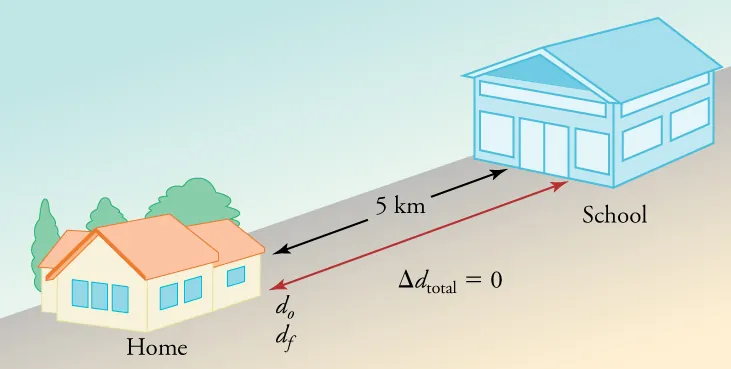
Imagine running one 400-meter lap and finishing exactly where you started. The distance is 400 meters because that is the path length. The displacement is 0 meters because the final position is the starting position.
More complete laps increase the distance, but after every complete lap the displacement is still zero.
06 / Practice
Practice
Check your understanding
A student walks 6 meters east and then 6 meters west, returning to the starting point. What are the student's distance and displacement?
Show the answer
The distance is 12 meters. The displacement is 0 meters.
Distance records the entire path: 6 meters plus 6 meters. Displacement compares only the final position with the starting position, which are the same.
Check your understanding
A hiker walks 300 m east, 400 m north, and then 300 m west. Determine the total distance and the final displacement. Explain why the east-west parts affect the two answers differently.
Show the answer
The total distance is 1,000 m. The final displacement is 400 m north.
Distance includes all three path segments: 300 m + 400 m + 300 m. The 300 m east and 300 m west changes in position cancel, leaving a net change of 400 m north. The vector answer is incomplete without the direction.
Continue the sequence
Continue learning
This page follows the opening scalar, vector, distance, and displacement lessons in the Kinematics course.
See the Kinematics course