Free Fall
Scroll horizontally to view every column.
| Situation | Interactions retained | Free-fall decision |
|---|---|---|
| A released object with air resistance neglected | Gravity only, directed downward near Earth's surface | Ideal free fall |
| An object moving through ordinary air when air resistance matters | Gravity and air resistance | Not the ideal free-fall model |
| An object attached to a stretched bungee cord or another tether | Gravity and tension from the stretched tether | Not the ideal free-fall model |
Model checkpoint
Which situation is ideal free fall?
Which mass reaches the ground first?
Picture two balls with the same physical size but different masses. They start side by side at the same height and are released at the same instant. Before reading on, predict which ball reaches the ground first.
Assumptions
- The two objects have the same physical size so size is not a second changing variable.
- They start at the same height, at the same time, at the same location, and from the same release conditions.
- Air resistance is neglected, so gravity is the only force retained in the model.
Commit to a prediction
Make a prediction before revealing the result. A common prediction is that the larger mass must accelerate more because Earth pulls on it more strongly, so it should reach the ground first.
Hold the setup fixed
The balls differ in mass, but their size, starting height, release time, location, initial velocity, and ideal free-fall conditions are the same. These matching initial conditions make their positions and arrival times a fair comparison.
Compare their accelerations
At the same location, both balls have the same acceleration due to gravity in the ideal model. That equality does not depend on their release heights or release times; those matching conditions are needed for the arrival-time comparison.
Compare equal-time snapshots
Because the balls begin together with the same initial velocity and acceleration, equal-time snapshots show them remaining level throughout the drop.
Result: Neither mass wins the idealized race: the two objects reach the shared ground line together. This conclusion is about acceleration in the same ideal free-fall conditions; it is not a claim that mass has no role in gravitational force or in every real falling situation.
Scroll horizontally to view every column.
| Condition | Observed motion | What the comparison means |
|---|---|---|
| Ordinary air | The hammer drops with little visible flutter while the feather flutters and lags | As the objects fall downward, air resistance acts upward, opposing their motion. Its effect is especially strong for the feather relative to the feather's weight, so this is not ideal free fall |
| Evacuated chamber | The hammer and feather accelerate together and arrive together when released from the same height | Removing air isolates the gravity-only prediction |
| An evacuated tube containing a penny and a piece of paper | After the air is removed, the lighter and heavier objects arrive together | A second qualitative demonstration of the same air-versus-vacuum result |
Open the full explanation
Mass does not change ideal free-fall acceleration
The central conclusion is specific: mass has no effect on ideal free-fall acceleration at the same location. If gravity is the only force retained and the release conditions match, a smaller-mass object and a larger-mass object share the same acceleration.
Keep the entire condition attached to the statement. A real object moving through air may behave differently because another force matters. The conclusion also does not say that gravitational force is independent of mass; that force relationship is deliberately left for the dynamics unit.
Explore air resistance without changing g
Switch between vacuum and air. Vacuum mode shows the ideal free-fall result. Air mode uses a simplified drag model with every assumed parameter displayed below it.
Compare vacuum and air
This model is illustrative, not a measurement of a particular real object.
Lighter sphere
Ready
Heavier sphere
Ready
| Object | Mass | Area | Drag coefficient |
|---|
Air mode uses Fdrag = ½ρCdAv² opposite the motion with ρ = 1.225 kg/m³. Vacuum mode sets drag to zero. All objects start together from 20 m with zero initial velocity.
Open the hands-on investigation and reasoning
Reasoning check: the same paper in two environments
Your task: Compare a flat sheet and the same sheet crumpled into a ball.
- Predict their motion when released together in a vacuum.
- Predict their motion when released together in air.
- Explain why a different arrival time in air does not mean the objects have different values of g.
Reasoning: In a vacuum, both pieces of paper have the same downward gravitational acceleration and the same starting conditions, so they remain together. In air, the flat sheet experiences much more drag relative to its mass. Its net acceleration and motion can therefore differ from the crumpled sheet even though the local gravitational acceleration is the same for both.
Acceleration due to gravity near Earth's surface
- a
- the object's signed acceleration in the one-dimensional free-fall model (m/s^2)
- g
- the signed local acceleration due to gravity (m/s^2)
- |g|
- the positive magnitude of the local acceleration due to gravity (m/s^2)
Assumptions
- Near Earth's surface, use the board-verified magnitude approximately 9.81 m/s².
- Choose a positive direction before assigning a sign. With upward positive, downward is negative and g = −9.81 m/s².
- If downward is chosen positive, the same physical acceleration is represented as g = +9.81 m/s².
- The sign communicates direction. A negative value of g does not by itself mean that an object is slowing down.
- Keep one coordinate convention throughout a problem.
Mousseau Tip
Scroll horizontally to view every column.
| Magnitude near Earth | How to use it | Accuracy boundary |
|---|---|---|
| 9.81 m/s² | The board-verified near-Earth magnitude used for careful work in this lesson | An approximate local value, not one exact value for every place |
| 9.8 m/s² | A common rounded form of the near-Earth magnitude | Slightly less precise than 9.81 m/s² |
| 10 m/s² | Quick-math estimate | Useful for estimation but deliberately less accurate and never exact |
Open the full explanation
Scroll horizontally to view every column.
| Stage with upward chosen positive | Velocity | Acceleration | Free-fall status |
|---|---|---|---|
| Rising after the ball leaves the hand | Upward and positive, with decreasing magnitude | Downward and negative; g remains approximately −9.81 m/s² | Yes, if air resistance is neglected |
| Highest point | Zero for one instant | Still downward and negative; it is not zero | Yes |
| Falling | Downward and negative, with increasing magnitude | The same downward and negative g | Yes |
Open the full explanation
Check your understanding
Air resistance is neglected after a ball is thrown straight upward. Is the ball in free fall while it rises, at the highest point, and while it falls? Identify the direction of its acceleration throughout the motion, and state both its velocity and acceleration at the highest point.
Show the answer
Confirm that gravity is the only relevant interaction, verify that the near-Earth motion covers only a modest height change so g can be treated as approximately constant, choose and keep a positive direction, assign g from that direction rather than from a memorized sign, and keep the object's velocity separate from its acceleration.
With upward chosen positive, the rising ball has positive velocity and negative acceleration. At the top its velocity is zero while its acceleration remains approximately −9.81 m/s². On the way down, both velocity and acceleration are negative. The following sections add AP-style reasoning and numerical practice; the next companion lesson provides a complete sequence of guided worked examples.
AP Physics reasoning
Connect a qualitative claim to an equation
From the same roof, ball A is launched upward and ball B is launched downward with the same initial speed. Air resistance is negligible.
- Predict which ball reaches the ground with the greater speed.
- Justify the prediction without equations.
- Use vf² = vi² + 2aΔy to show how the equation represents the same reasoning.
Show the qualitative and quantitative reasoning
Prediction: The balls reach the ground with the same speed.
Qualitative reasoning: Ball A first rises and returns to roof height with the same speed magnitude it had at launch, now directed downward. At that instant, it has the same position and downward speed as ball B had at launch. From there, the remainder of their motion is identical. Ball A takes longer to arrive, but it does not arrive faster.
Equation connection: Both balls have the same vi², the same downward acceleration, and the same displacement from the roof to the ground. Therefore vf²—and thus final speed—is the same for both.
AP Physics checkpoint
Set up the model before substituting numbers
A stone is released from rest 45 m above the ground. Air resistance is negligible. Choose upward as positive and use the AP value |g| = 10 m/s². How long does the stone take to reach the ground, and what is its velocity immediately before impact?
Before calculating:
- State why the free-fall model applies.
- Write vi, Δy, and a with signs and units.
- Choose an equation for the time, then an equation for the final velocity.
- Solve both parts and interpret the sign of the velocity.
Show the setup and reasoning
Gravity is the only force included, so the constant-acceleration model applies. With upward positive, Δy = −45 m, vi = 0, and a = −10 m/s².
Using Δy = vit + ½at² gives −45 m = 0 + ½(−10 m/s²)t², so t = 3.0 s. Then vf = vi + at = 0 + (−10 m/s²)(3.0 s) = −30 m/s.
The negative sign identifies the downward direction. The impact speed is 30 m/s.
Explore the motion
Move through a drop or an upward toss using the object, velocity and acceleration arrows, and numerical values. You do not need motion graphs for this part.
Released from rest
Current motion values
ground = 020.00 m
Show the mathematical model and limits
Position: y = y₀ + v₀t + ½at²
Velocity: v = v₀ + at
With upward positive and ground at y = 0, the initial coordinate is y₀ = +20 m and the initial velocity for a drop is v₀ = 0 m/s.
The explorer models one-dimensional motion near Earth with constant gravitational acceleration and no air resistance. Changing the positive direction changes signed coordinates and vector components, not the physical motion.
Show motion graphs for the current model
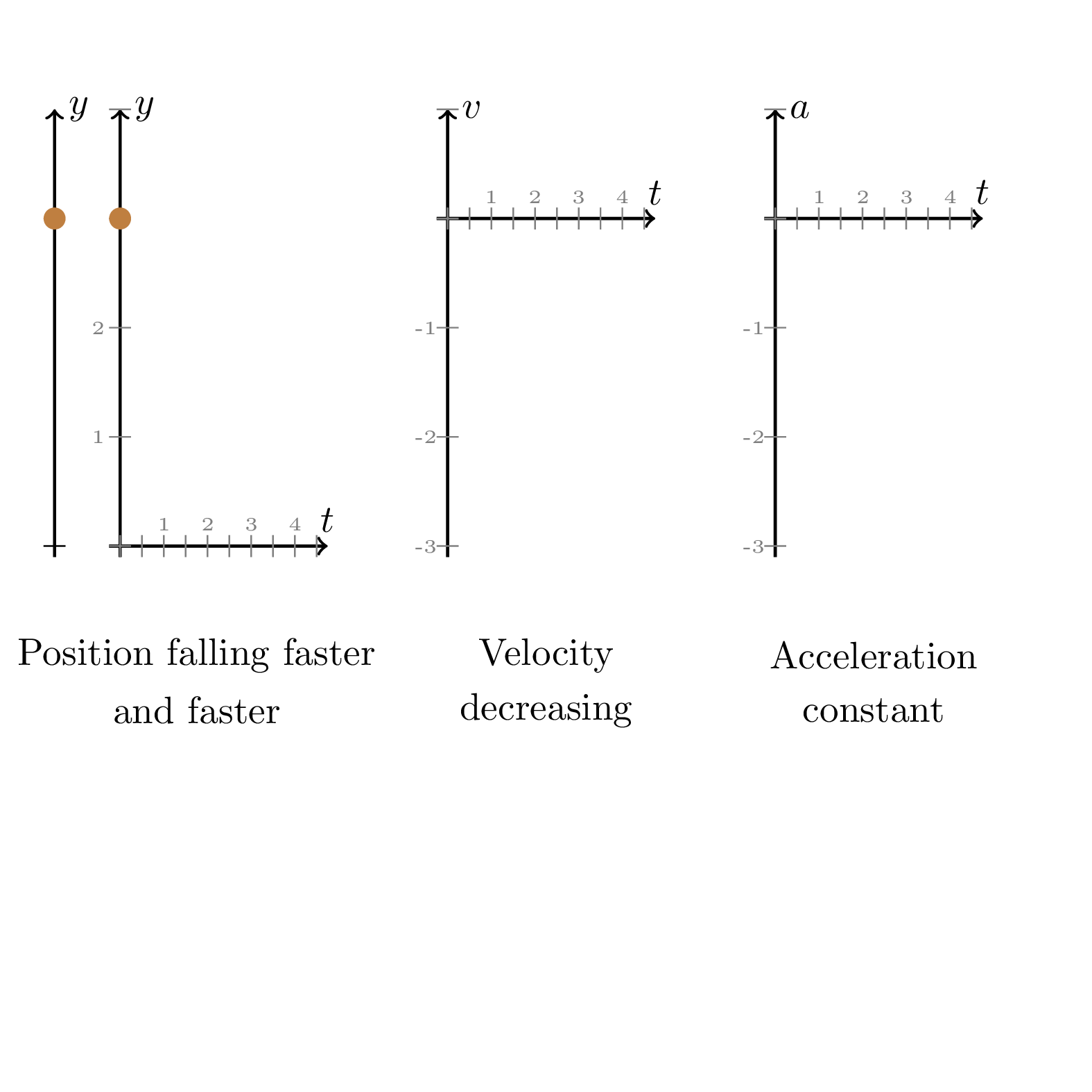
These graphs use the explorer's current scenario, height, value of g, positive direction, and time. Change a control above and all three graphs update with the object and numerical readouts.
The graphs currently show a drop from 20 m with upward positive.
Challenge checks
Use these to test whether you can reason beyond a one-step substitution.
Delayed drops: speed difference versus separation
Ball A is released from rest. One second later, ball B is released from the same point. Ignore air resistance. While both balls are falling, determine what happens to:
- the difference between their speeds, and
- the distance separating them.
Show answer and reasoning
Answer: The speed difference remains constant, but the separation increases. Once B is released, both velocities change by the same amount each second because both accelerations equal g. Ball A keeps the speed advantage it gained during the first second, so it continues to pull farther ahead at a constant relative speed.
Same height twice: compare v, speed, and a
A ball passes the same height once while rising and again while falling. Ignore air resistance. Compare its velocity, speed, and acceleration at those two instants.
Show answer and reasoning
Answer: The speeds are equal, but the velocities point in opposite directions. The acceleration is the same downward vector at both instants. With upward positive, the two velocities have equal magnitudes and opposite signs, while a remains negative.
Transfer to another planet
At one location on another planet, a ball released from rest falls 10.0 m in 4.0 s. Choose downward as positive and find the planet’s free-fall acceleration. At the same location, predict how far a ball with twice the mass falls from rest in 2.0 s.
Show answer and reasoning
Answer: With downward positive, Δy = +10.0 m and Δy = ½at² gives a = +1.25 m/s². Mass does not change ideal free-fall acceleration at the same location, so the second ball falls ½(1.25 m/s²)(2.0 s)² = 2.5 m downward.
Common mistakes
- Negative does not automatically mean slowing down. Compare the directions of velocity and acceleration.
- Acceleration is not zero at the top. Velocity is zero for one instant, but gravitational acceleration remains downward.
- Heavier objects do not have a larger g. At the same location, ideal free-fall acceleration is independent of object mass.
- Moving downward does not define free fall. Decide which forces matter.
Open the complete Free Fall Study Sheet
Free Fall Study Sheet
Model, signs, equations, reasoning, and AP expectations
This HTML study sheet is the accessible primary version. Printing creates a one-page convenience copy.
Free-fall model
- Gravity is the only force included.
- The object may move upward, be momentarily at rest, or move downward.
- When air resistance matters, the ideal model no longer describes the full motion.
Values of g near Earth
- General work: |g| ≈ 9.81 m/s².
- AP Physics: use |g| ≈ 10 m/s² unless a different value is supplied.
- Assign the sign from the chosen positive direction.
Direction and speed during an upward toss
| Part of motion | Velocity | Acceleration | Speed |
|---|---|---|---|
| Rising | Positive | Negative | Decreasing |
| Highest point | Zero for an instant | Negative, not zero | Zero for an instant |
| Falling | Negative | Negative | Increasing |
Choose an equation from the knowns and the target
Displacement with time: Δy = vit + ½at²
Velocity with time: vf = vi + at
No time: vf² = vi² + 2aΔy
Displacement from average velocity: vavg = ½(vi + vf), so Δy = vavgt
Problem setup routine
- State the model and neglect air only when justified.
- Choose a positive direction.
- Write knowns with signs and units.
- Select an equation that contains the target and knowns.
- Interpret the sign and check units.
Reasoning you should be able to defend
- At the same location, mass does not change ideal free-fall acceleration.
- Zero velocity does not require zero acceleration.
- Velocity and acceleration in the same direction mean speed increases.
- At equal heights, an upward toss has equal speeds on the way up and down when air is neglected.
Mastery check
- I can decide whether a situation fits the free-fall model from the forces, not from the direction of motion.
- I can assign the sign of a without automatically treating g as negative.
- I can solve a drop or upward-toss problem and explain what the result means.
- I can justify a prediction in words and connect that reasoning to an equation.
Sources and model boundaries
The core teaching sequence follows the verified Free Fall course lesson. The AP-style checks and study prompts are companion-page additions based on verified classroom materials. They are not quotations or transcript dictation.
The air-resistance comparison is an illustrative quadratic-drag model using the parameters displayed in the tool. It is not a measurement of a particular sheet of paper, sphere, or real drop.