Dynamics and Forces
Newton’s third law
01 / Newton’s third law
Newton’s third law
A force never belongs to only one side of an interaction
When object A exerts a force on object B, object B simultaneously exerts a force of equal magnitude in the opposite direction on object A. These two forces form an interaction pair.
The traditional names are action and reaction, but neither force happens first. Either member may be called the action as long as the other is identified as its partner.
Newton’s third law for two interacting objects
- F(A on B)
- the force exerted by object A on object B (newton (N))
- F(B on A)
- the force exerted by object B on object A (newton (N))
Assumptions
- The two forces come from the same interaction.
- They have equal magnitudes and opposite directions.
- They act on different objects at the same time.
Scroll horizontally to view every column.
| Test | What must be true |
|---|---|
| Same interaction | Both forces arise from the same contact or field interaction |
| Equal magnitude | The two forces have the same size |
| Opposite direction | Their vectors point in opposite directions |
| Different objects | Each force acts on the other object |
02 / Equilibrium versus force pairs
Equilibrium versus force pairs
First separate equilibrium from Newton’s third law
Equilibrium describes the forces acting on one chosen object or system. If their vector sum is zero, the object’s acceleration is zero and its velocity remains constant.
An equilibrant is a force that is equal in magnitude and opposite in direction to the resultant of the other forces. Adding it brings the net force to zero. More than two forces may combine to produce equilibrium.
Translational equilibrium
- the vector sum of all external forces acting on the chosen object or system (newton (N))
Assumptions
- All forces in the sum act on the same chosen object or system.
- Zero net force means zero acceleration, not necessarily zero velocity.
Scroll horizontally to view every column.
| Question | Balanced or equilibrant forces | Newton’s third-law pair |
|---|---|---|
| Where do the forces act? | On the same object or system | On two different interacting objects |
| What do they describe? | The net force and acceleration of one system | The mutual interaction between two systems |
| Can they cancel in one free-body diagram? | Yes, if their vector sum is zero | No; both do not belong on the same one-object diagram |
03 / Interaction examples
Interaction examples
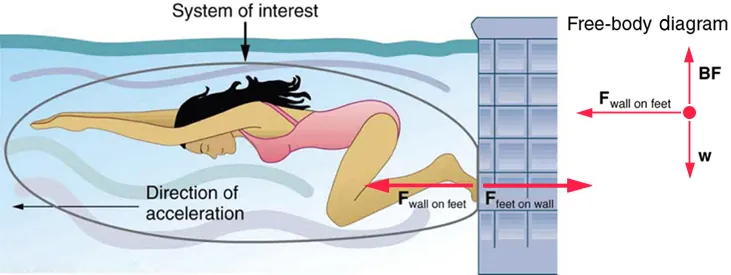
A swimmer moves left by pushing the wall right
A swimmer who wants to accelerate away from the wall pushes the wall with her feet. If she pushes the wall to the right, the wall pushes her feet to the left with the same force magnitude.
The force that accelerates the swimmer is the wall’s force on the swimmer—not the swimmer’s force on the wall. Those forces are a pair, but they act on different objects.
Check your understanding
For a free-body diagram of the swimmer, should the swimmer’s force on the wall be included? Which horizontal force should appear instead?
Show the answer
Do not include the swimmer’s force on the wall because it acts on the wall. Include the wall’s force on the swimmer because it acts on the chosen system.
A free-body diagram contains forces acting on the selected object or system. The partner force belongs on a diagram of the other object.
Walking uses the same pattern
To accelerate forward, a person’s foot pushes backward on the ground. The ground exerts a forward static-friction force on the foot.
On a free-body diagram of the person, draw the ground’s force on the person. The person’s backward force on the ground belongs to the ground’s interaction picture, not the person’s free-body diagram.
04 / System boundaries
System boundaries
The chair example: weight and normal force are not a third-law pair
A person sitting motionless on a chair has weight downward and a normal force upward. Those two forces may have equal magnitudes because the person is in equilibrium, but both act on the person. They are not a Newton’s third-law pair.
Each force has its own partner on a different object. Earth pulls the person downward while the person pulls Earth upward. The chair pushes the person upward while the person pushes the chair downward.
Scroll horizontally to view every column.
| Force acting on the person | Its third-law partner | Why it is a pair |
|---|---|---|
| Earth pulls person downward | Person pulls Earth upward | Same gravitational interaction; different objects |
| Chair pushes person upward | Person pushes chair downward | Same contact interaction; different objects |
Check your understanding
The chair is suddenly removed. Which force on the person disappears, and does the gravitational third-law pair still exist?
Show the answer
The chair’s normal force disappears because contact ends. Earth still pulls the person downward, and the person still pulls Earth upward with an equal-magnitude gravitational force.
The normal force was never the partner of weight. Removing the chair exposes the distinction.
05 / Gravitational force pairs
Gravitational force pairs
Equal forces can produce very different accelerations
Earth pulls a person downward, and the person pulls Earth upward with an equal force magnitude. The accelerations are not equal because acceleration also depends on mass.
The same logic applies to Earth and the Moon: each pulls on the other with an equal-magnitude force, but their accelerations depend on their different masses.

Equal interaction-force magnitudes, mass-dependent accelerations
- |F|
- the magnitude of an interaction force (newton (N))
- m
- the mass of the object whose acceleration is being analyzed (kilogram (kg))
- |a|
- the acceleration magnitude of that object (meter per second squared (m/s²))
Assumptions
- Compare the third-law forces, then apply Newton’s second law separately to each object.
- Other external forces may also contribute to each object’s net force.
06 / Practice and summary
Practice and summary
Check your understanding
A hand strikes a heavy padded wall. Which experiences the larger force during their interaction: the hand or the wall? Must they have equal accelerations?
Show the answer
The hand and wall exert equal-magnitude forces on one another. Their accelerations need not be equal because the relevant masses and other forces are different.
Newton’s third law compares the two interaction forces. Newton’s second law determines each object’s acceleration from its own net force and mass.
Check your understanding
A book rests on a table. Complete the partner statement for “the table pushes upward on the book,” then explain why the book’s weight is not that partner.
Show the answer
The partner is “the book pushes downward on the table.” The book’s weight is Earth pulling downward on the book; it is a different interaction and also acts on the book rather than on the table.
Reverse the two object names while keeping the same interaction. A valid pair has one force on each object.
AP Physics Focus: name the objects and respect the system boundary
AP Physics 1 expects paired forces to be represented as F(A on B) = −F(B on A). A correct explanation names both objects, states that the forces are equal in magnitude and opposite in direction, and identifies that they act on different objects.
If both interacting objects are inside one chosen system, their interaction forces are internal and do not change the system’s center-of-mass motion. If only one object is selected, the force exerted by the other object is external to that system.
Check your understanding
A small cart collides with a much more massive cart. During contact, a student claims the massive cart exerts a larger force because it is harder to accelerate. Evaluate the claim.
Show the answer
The claim is incorrect. During the interaction, each cart exerts the same force magnitude on the other in opposite directions. The smaller cart can have the larger acceleration because a = Fnet/m and its mass is smaller.
Do not confuse force equality from Newton’s third law with acceleration, which depends on each cart’s mass and net force.
Scroll horizontally to view every column.
| Step | Question |
|---|---|
| 1 | What two objects are interacting? |
| 2 | What force does A exert on B? |
| 3 | What equal-and-opposite force does B exert on A? |
| 4 | Which force acts on the object or system being analyzed? |
| 5 | Are any equal-and-opposite forces on the same object actually an equilibrium relationship instead? |
Continue the sequence
Continue learning
This page follows the Newton’s Third Law lesson in the Dynamics course.
See the Dynamics / Forces course