Dynamics and Forces
Newton’s second law
01 / Newton’s second law
Newton’s second law
What determines an object’s acceleration?
Newton’s first law identifies when velocity remains constant. Newton’s second law quantifies what happens when the net external force is not zero.
Acceleration depends on two things: the vector sum of the external forces and the object or system’s mass.
Newton’s second law
- the vector sum of external forces (newton (N))
- m
- the mass of the object or system (kilogram (kg))
- a
- the acceleration of the object or system (meter per second squared (m/s²))
Assumptions
- Choose the object or system before summing forces.
- Use a consistent coordinate direction and signs.
- Mass is positive; acceleration points in the same direction as the net force.
Scroll horizontally to view every column.
| Force | Equivalent base units | Meaning |
|---|---|---|
| 1 N | 1 kg·m/s² | The net force that accelerates 1 kg at 1 m/s² |
02 / Force, mass, and acceleration
Force, mass, and acceleration
Scroll horizontally to view every column.
| What stays fixed | What changes | Acceleration response |
|---|---|---|
| Mass | Net force increases | Acceleration increases in direct proportion |
| Net force | Mass increases | Acceleration decreases in inverse proportion |
| Desired acceleration | Mass increases | A larger net force is required |
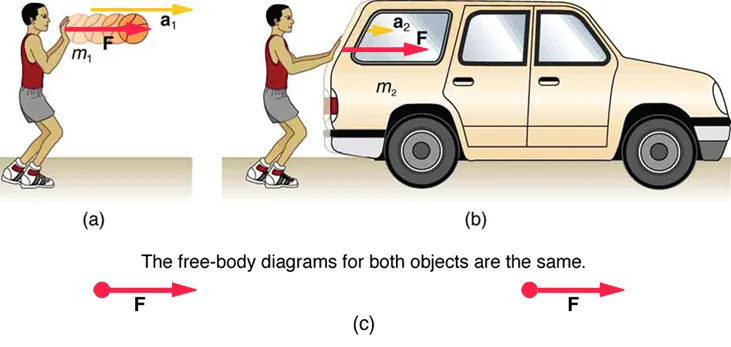
Check your understanding
The same net force acts on a small car and a fully loaded truck. Which has the greater acceleration? What must change if both are to have the same acceleration?
Show the answer
The small car has the greater acceleration because its mass is smaller. To give the more massive truck the same acceleration, the truck needs a proportionally larger net force.
Use a = /m. At fixed net force, larger mass means smaller acceleration.
03 / Direction and force diagrams
Direction and force diagrams
Acceleration follows the net force—not necessarily the velocity
The acceleration vector points in the same direction as the net external force. It does not have to point in the same direction as the object’s velocity.
A ball at the highest point of an upward toss has zero instantaneous velocity, but gravity still produces a downward net force and downward acceleration.
04 / Worked examples
Worked examples
Find the required net force
What net force is required to accelerate a 6 kg object at 2 m/s²?
Assumptions
- The stated 2 m/s² is the acceleration produced by the net external force.
- Use magnitudes because no competing directions are specified.
Write Newton’s second law
The unknown is the net force.
Substitute mass and acceleration
Keep the units attached to the values.
Multiply and simplify units
Kilogram meters per second squared are newtons.
Result: A net force of 12 N produces the stated acceleration.
Scroll horizontally to view every column.
| Condition | Newton-law statement | Motion consequence |
|---|---|---|
| Net force is zero | = 0 | Acceleration is zero; velocity is constant |
| Net force is nonzero | = ma | Acceleration is nonzero; velocity changes |
05 / Mass, weight, and normal force
Mass, weight, and normal force
Scroll horizontally to view every column.
| Quantity | Meaning | Typical behavior |
|---|---|---|
| Mass m | A measure of inertia | Remains the same when the object moves to a different gravitational environment |
| Weight | The gravitational force on the object | Changes when the local gravitational field strength changes |
Weight near a planetary surface
- the gravitational force or weight (newton (N))
- m
- mass (kilogram (kg))
- g
- the local gravitational field strength, numerically equal to the free-fall acceleration magnitude (newton per kilogram (N/kg) or meter per second squared (m/s²))
Assumptions
- Use the local value of g supplied or expected for the problem.
- Assign the force a sign only after choosing a coordinate direction.
AP Physics Focus: near Earth, use 10 N/kg when the AP framework does
The current AP Physics 1 framework uses a near-Earth gravitational field strength of 10 N/kg. That is numerically equivalent to a free-fall acceleration magnitude of 10 m/s².
Outside an AP context, a problem may specify 9.8 m/s², 9.81 m/s², or another local value. Use the convention supplied by the problem or course.
Use motion to complete a force diagram
A person sits at rest on a horizontal chair. Weight acts downward. What other force must act, and what relationship follows?
Assumptions
- The person is the chosen system.
- The person remains at rest, so acceleration and net force are zero.
- No other vertical forces act.
Use the motion condition
Rest is constant velocity, so the vertical forces balance.
Write the signed force sum
Choose upward as positive. The chair’s normal force is upward and weight is downward.
Solve the relationship
The equality follows from this specific equilibrium situation, not from the definition of normal force.
Result: The chair exerts an upward normal force equal in magnitude to the person’s weight in this situation.
Combine opposing forces before using = ma
A 12 N force acts right and a 5 N force acts left on a 7 kg object. Find the net force and acceleration.
Assumptions
- Choose right as positive.
- The two stated horizontal forces are the complete horizontal force inventory.
Add forces with signs
The net force is 7 N to the right.
Apply Newton’s second law
Use the net force, not either individual force, in the numerator.
Substitute and calculate
The positive sign means the acceleration points right.
Result: The object has a net force of 7 N right and an acceleration of 1 m/s² right.
06 / Practice and summary
Practice and summary
Check your understanding
A system’s mass doubles while the same net force continues to act. What happens to the acceleration, and how should the claim be justified?
Show the answer
The acceleration becomes one-half as large. From a = /m, acceleration is inversely proportional to mass when net force is held constant.
State what is held fixed, identify the inverse relationship, and give the factor of change.
Scroll horizontally to view every column.
| Step | Action |
|---|---|
| 1 | Choose the object or system and coordinate direction |
| 2 | Draw the individual external forces |
| 3 | Decide whether the net force is zero or nonzero |
| 4 | Write the signed component equation = ma |
| 5 | Substitute values with units and solve |
| 6 | Interpret the sign and check whether the result is reasonable |
Continue the sequence
Continue learning
This page follows the Newton’s Second Law lesson in the Dynamics course.
See the Dynamics / Forces course