Dynamics and Forces
Newton’s first law
01 / Newton’s first law
Newton’s first law
Dynamics asks what changes motion
Kinematics describes position, velocity, and acceleration. Dynamics explains why velocity changes. Newton’s first law begins with the case in which the combined external force is zero.
The law applies to both parts of velocity: speed and direction. An object that speeds up, slows down, or turns has changed velocity.
Scroll horizontally to view every column.
| Net-force condition | Acceleration | Velocity |
|---|---|---|
| = 0 | a = 0 | Velocity remains constant |
| ≠ 0 | a ≠ 0 | Velocity changes in magnitude, direction, or both |
02 / Zero net force and velocity
Zero net force and velocity
Rest is not the only zero-net-force outcome
A stationary object can have zero net force, but so can an object moving steadily in a straight line. Rest is simply the constant-velocity case in which the velocity equals zero.
Zero net force does not mean that no forces act. Several forces may act and balance so their vector sum is zero.
Mousseau Emphasis: force changes motion; it does not maintain motion
A continuing force is not required to keep an object moving at constant velocity. A net force is required to change its velocity.
A single push can set an object in motion. After contact ends, the object does not need to carry a leftover “force of motion.” What happens next depends on the other forces that still act.
03 / Why objects stop
Why objects stop
Why do moving objects usually stop?
A ball rolled across a floor eventually slows because resistive interactions remain. Friction with the surface, rolling resistance, and air resistance can produce a net force opposite the motion.
Reduce those resistive forces and the motion lasts longer. A hockey puck glides much farther across smooth ice than a similar object sliding across a rough floor. In a region where external forces are negligible, an object already in motion continues with essentially constant velocity.
Check your understanding
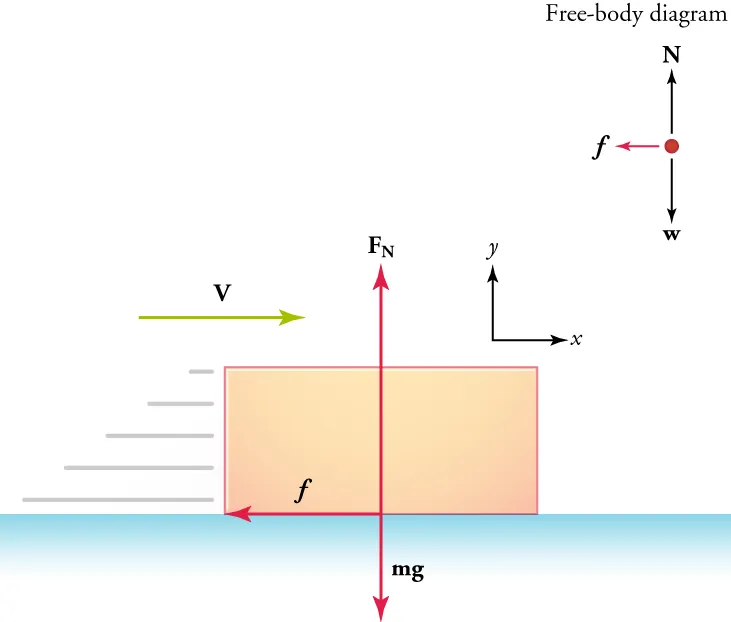
A crate is pushed to the right and then released on a surface with friction. Immediately after the hand loses contact, which horizontal force remains, and how does the crate’s velocity change?
Show the answer
The applied force from the hand is gone. Friction remains and points opposite the crate’s motion, producing a net force and acceleration to the left. The crate is still moving right at first, but its rightward speed decreases.
Velocity and net force do not have to point in the same direction. A leftward net force changes a rightward velocity by making it smaller.
04 / How velocity changes
How velocity changes
Scroll horizontally to view every column.
| What changes | What you observe |
|---|---|
| Speed increases | The object speeds up |
| Speed decreases | The object slows down |
| Direction changes | The path bends or turns |
05 / Inertia and mass
Inertia and mass
Inertia depends on mass—not speed
A 27 kg object has more inertia than a 4 kg object regardless of whether either object is at rest or moving. The larger mass resists a change in velocity more strongly.
Speed can matter greatly for momentum, kinetic energy, and damage, but it does not determine inertia. A moving bullet and the same bullet at rest have the same inertia because their mass is the same.
Check your understanding
Which has more inertia: a fast-moving bullet or a full-size train at rest?
Show the answer
The train has more inertia because it has far more mass. The bullet’s high speed affects other quantities, including momentum and kinetic energy, but not its inertia.
Do not use speed to rank inertia. Compare mass.
06 / AP Physics focus
AP Physics focus
AP Physics Focus: justify constant velocity from net force
For AP Physics 1, connect the vector statement = 0 to constant velocity. Translational equilibrium includes both an object at rest and an object moving with constant nonzero velocity.
Forces may balance in one direction while remaining unbalanced in another. The velocity changes only in the direction of the unbalanced net force. Newton’s first law is evaluated from an inertial reference frame.
Check your understanding
A cart moves right at constant speed on a level track. Its weight and normal force balance vertically. What must be true about the horizontal net force, and what evidence supports the claim?
Show the answer
The horizontal net force must be zero. The evidence is the cart’s constant velocity: its speed and direction are not changing, so its acceleration is zero.
The conclusion is about the net force. It does not prove that no horizontal forces act; any horizontal forces that do act must balance.
Scroll horizontally to view every column.
| Question | Decision |
|---|---|
| Is the net external force zero? | Velocity remains constant, including the possibility of rest |
| Is the net external force nonzero? | Velocity changes in magnitude, direction, or both |
| Which object has more inertia? | The object with more mass |
| Why did an everyday object stop? | Identify the resistive interaction instead of inventing a need for a sustaining force |
Continue the sequence
Continue learning
This page follows the Newton’s First Law and inertia lesson in the Dynamics course.
See the Dynamics / Forces course