Dynamics and Forces
Force foundations
01 / Force foundations
Force foundations
From describing motion to explaining changes in motion
Kinematics describes position, velocity, and acceleration. Dynamics asks what interactions cause an object's motion to change.
This first lesson establishes the language and diagrams needed for the rest of the unit. Newton's laws, friction, inclined planes, circular motion, and gravitation will build on these foundations in their own lessons.
Scroll horizontally to view every column.
| Quantity | Common notation | SI unit |
|---|---|---|
| An individual force | F with a descriptive subscript | newton (N) |
| Net force | or | newton (N) |
02 / Build a free-body diagram
Build a free-body diagram
Choose the object before listing forces
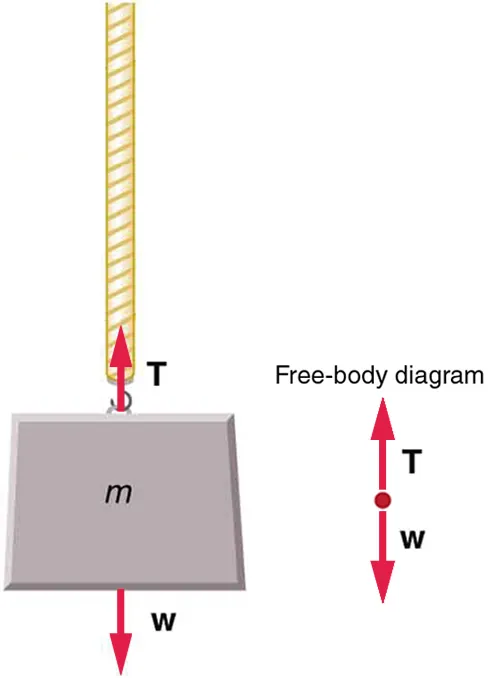
A free-body diagram is always about one chosen object or system. Name that object first, then ask what other objects in the environment exert forces on it.
The direction of each arrow is the direction of the force acting on the chosen object—not the direction the object happens to be moving.
Build a free-body diagram
Represent the forces acting on one chosen object without copying the entire physical scene.
Assumptions
- Treat the object as a particle when its shape and rotation are not part of the model.
- Include only external forces acting on the chosen object.
Replace the chosen object with a dot, box, or circle
The simplified object keeps attention on its interactions rather than its artwork.
Identify every actual external force acting on it
Look for gravitational, support, frictional, applied, tension, and resistive interactions that are genuinely present.
Draw and label one vector for each force
Arrows point away from the object in the force direction. Their relative lengths should communicate relative force magnitudes when that information is known.
Keep velocity and acceleration off the force diagram
Those vectors may be drawn beside the diagram for reference, but they are not forces acting on the object.
Result: A useful free-body diagram contains the chosen object and its individual external force vectors—nothing else.
03 / Common forces
Common forces
Scroll horizontally to view every column.
| Force | Common notation | Interaction to recognize |
|---|---|---|
| Weight or gravitational force | W or | The gravitational interaction with Earth or another attracting body |
| Normal force | A support interaction exerted by a contacting surface | |
| Friction | A contact interaction between surfaces that resists relative sliding or the tendency to slide | |
| Applied force | A push or pull exerted by a person, engine, or other named agent | |
| Tension | A pulling interaction transmitted by a taut rope, string, or wire | |
| Resistive force | A resistance such as air drag that acts through the surrounding medium |
04 / Individual and net force
Individual and net force
Scroll horizontally to view every column.
| Individual forces | Net force |
|---|---|
| Each arrow represents a real interaction exerted by another object or system. | The vector result after all individual forces are added. |
| These belong on a free-body diagram. | Calculate it from the individual forces; do not add it as one more interaction arrow. |
| Several nonzero forces may act at once. | Their vector sum may still be zero if they balance. |
Check your understanding
A book rests on a level table. Which items belong on the book's free-body diagram: its downward velocity, its downward weight, its upward normal force, its acceleration, or a separate net-force arrow?
Show the answer
Show the downward weight and upward normal force. Do not include velocity or acceleration because they are not forces. Do not add net force as another interaction arrow; determine the net force from the individual force vectors.
The diagram is an inventory of external interactions acting on the book. The book can be at rest while nonzero forces act and balance.
05 / AP Physics focus
AP Physics focus
AP Physics Focus: make the interaction visible
For AP Physics 1, identify the object or system first and draw each force exerted on it by the environment as an individual straight arrow originating on the dot.
The current AP framework expects forces—not force components—on the free-body diagram. If multiple forces point in the same direction, draw their arrows side by side rather than overlapping them. Labeling the agent and receiver, such as “Earth on book,” makes the interaction unambiguous.
06 / Mistakes and final check
Mistakes and final check
Check your understanding
Two horizontal forces act on a cart: 8 N to the right and 8 N to the left. What belongs on the free-body diagram, and what is the horizontal net force?
Show the answer
Draw both individual horizontal force arrows, one right and one left, with equal lengths. Their horizontal vector sum is 0 N.
Zero net force does not mean no forces act. It means the individual force vectors balance.
Continue the sequence
Continue learning
This page follows the opening force and free-body-diagram lesson in the Dynamics course.
See the Dynamics / Forces course