Dynamics and Forces
Diagram-to-equation workflow
01 / Diagram-to-equation workflow
Diagram-to-equation workflow
Scroll horizontally to view every column.
| Step | What to put on paper |
|---|---|
| 1. Choose the system | Name the one object or system being analyzed |
| 2. Draw the free-body diagram | Include every external force acting on that system—and no motion arrows |
| 3. Choose axes | State which directions are positive |
| 4. Write dynamics by axis | Use x = max and y = may separately |
| 5. Substitute and solve | Keep signs and units attached |
| 6. Interpret | Translate the sign of the result into a physical direction |
02 / Thrown-ball forces
Thrown-ball forces
A ball can move upward while the net force points downward
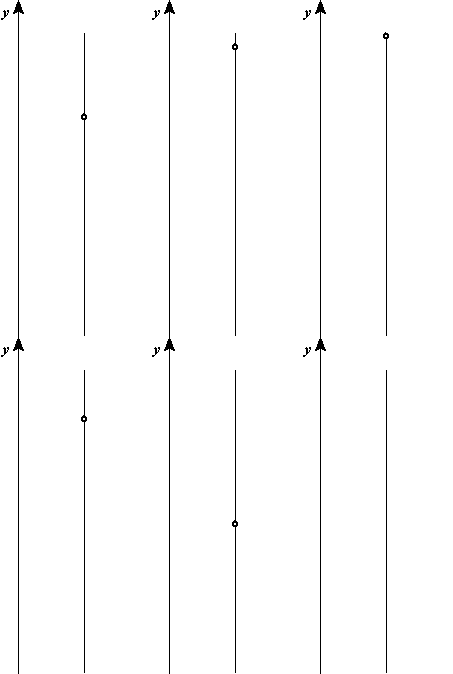
Consider a ball after it has left the hand but before it reaches its highest point. The ball’s velocity points upward. If air resistance is neglected, the only force acting on the ball is its weight, directed downward.
The hand is no longer touching the ball, so there is no continuing upward applied force. The downward net force produces a downward acceleration even while the ball is still moving upward.
Scroll horizontally to view every column.
| Moment | Velocity | Force and acceleration |
|---|---|---|
| Rising | Upward | Weight downward; acceleration downward |
| At the highest point | Zero for one instant | Weight downward; acceleration downward |
| Falling | Downward | Weight downward; acceleration downward |
Check your understanding
At the highest point, what are the ball’s velocity, acceleration, and net force if air resistance is neglected?
Show the answer
The instantaneous velocity is zero. Acceleration points downward with magnitude g, and the net force is the ball’s weight, mg, downward.
Zero velocity at one instant does not imply zero acceleration or zero net force.
03 / Accelerating car
Accelerating car
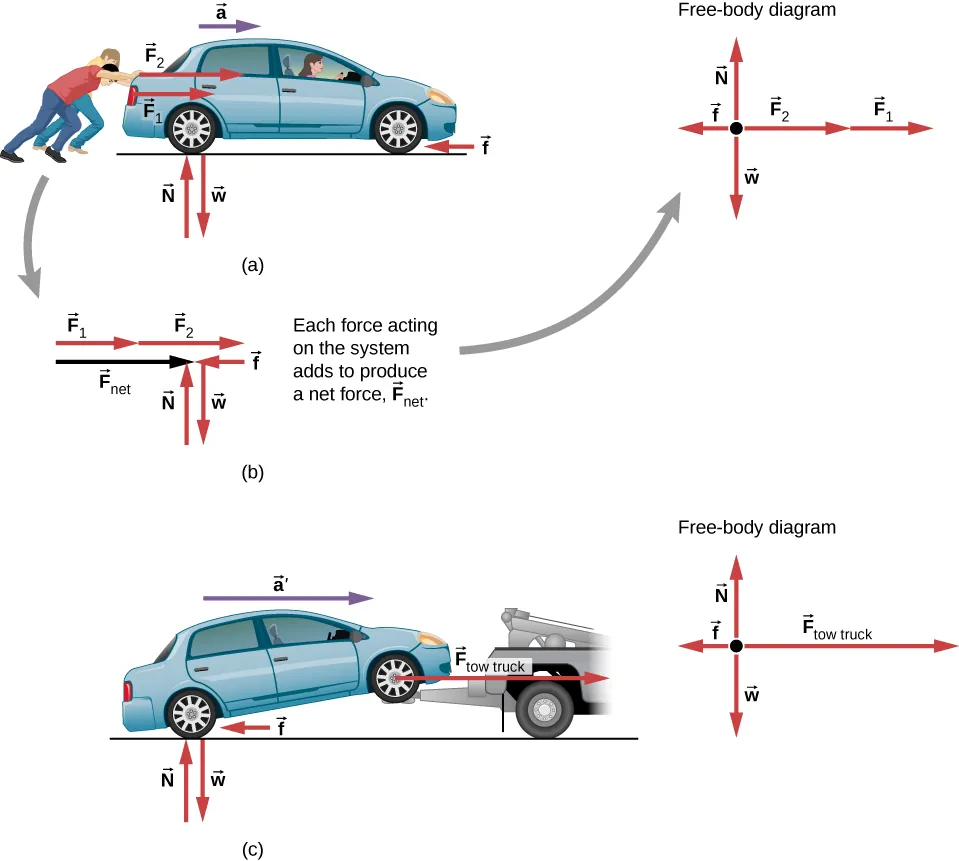
Write one Newton’s second law equation for each axis
ᵧ = F(normal) − F(weight) = 0; ₓ = F(drive) − F(resistive) = maₓ
- FN
- normal force exerted by the road on the car (newton (N))
- Fg
- weight of the car (newton (N))
- Fdrive
- forward external driving force in this model (newton (N))
- Fresist
- leftward resistive force in this model (newton (N))
- ax
- horizontal acceleration (meter per second squared (m/s²))
Assumptions
- Choose right and up as positive.
- The road is level and the car has no vertical acceleration.
- The listed forces are the complete external-force inventory for the simplified model.
04 / Complete force example
Complete force example
Solve a complete two-axis force problem
A 12 kg object is supported on a horizontal surface. It experiences 8 N right, 7 N left, and 10 N left. Find its weight, normal force, and horizontal acceleration. Use g = 9.81 m/s².
Assumptions
- Choose right and up as positive.
- The object has no vertical acceleration.
- The stated forces are the complete force inventory.
Find the weight magnitude
F(weight) = mg = (12 kg)(9.81 m/s²) = 117.72 N
Weight acts downward. The calculated value is its magnitude.
Use vertical equilibrium
ᵧ = F(normal) − F(weight) = 0 → F(normal) = 117.72 N
In this specific situation, the normal force equals the weight because no other vertical forces act and ay = 0.
Add the horizontal forces with signs
ₓ = 8 N − 7 N − 10 N = −9 N
The negative net force points left.
Apply Newton’s second law
aₓ = ₓ/m = (−9 N)/(12 kg) = −0.75 m/s²
The acceleration points left. The sign does not reveal the object’s current velocity.
Result: Weight is 117.72 N downward, normal force is 117.72 N upward, and acceleration is 0.75 m/s² left.
Check your understanding
The calculated acceleration is −0.75 m/s². Must the object be moving left?
Show the answer
No. The negative sign says the acceleration points left under the chosen axis convention. The object could be moving left, at rest at that instant, or moving right while slowing down.
Acceleration describes the direction of velocity change, not necessarily the current direction of velocity.
05 / Angled push
Angled push
An angled push changes both horizontal and vertical force balances
When a lawnmower is pushed down and to the right along its handle, the applied force has a rightward component and a downward component. The rightward component can balance friction during constant-velocity motion.
The downward component adds to the mower’s weight. The ground must therefore exert a normal force larger than the weight alone. This is why FN = Fg is not a universal rule.
Constant-velocity lawnmower model
ₓ = F(applied,x) − f = 0; ᵧ = F(normal) − F(weight) − F(applied,y) = 0
- Fapp,x
- rightward component of the applied push (newton (N))
- Fapp,y
- downward component magnitude of the applied push (newton (N))
- f
- friction opposing the mower’s sliding motion (newton (N))
- FN
- normal force exerted by the ground (newton (N))
Assumptions
- The mower moves at constant velocity, so acceleration is zero in both axes.
- The applied push is resolved into perpendicular horizontal and vertical components.
- The applied vertical component points downward.
Check your understanding
For the constant-velocity lawnmower, is the normal force smaller than, equal to, or larger than the mower’s weight?
Show the answer
It is larger: FN = Fg + Fapp,y. The surface supports both the mower’s weight and the downward component of the applied push.
Normal force must be determined from the vertical dynamics equation; it is not automatically equal to weight.
06 / AP Physics focus
AP Physics focus
AP Physics Focus: model first, then calculate
AP Physics 1 problems reward a defensible representation: identify the system, draw only external forces, choose axes, and write separate component equations before substituting numbers. A velocity or acceleration arrow may be shown near a free-body diagram for context, but it must not be counted as a force.
This page preserves the lesson’s 9.81 m/s² value in the numerical example. On AP Physics 1 work, use the value supplied by the problem; when none is supplied, AP allows and encourages the convenient near-Earth approximation g = 10 m/s².
Check your understanding
A student writes FN = Fg for every object on a horizontal surface. Use the lawnmower example to evaluate the claim.
Show the answer
The claim is false. FN equals Fg only when the vertical force sum and acceleration make that relationship true. A downward applied component gives FN = Fg + Fapp,y.
Normal force is a contact response determined from the full vertical force equation.
Scroll horizontally to view every column.
| Example | Central decision |
|---|---|
| Ball after release | Motion direction does not create an extra force |
| Accelerating car | Separate balanced vertical forces from unbalanced horizontal forces |
| 12 kg object | Add signed forces first, then divide the net force by mass |
| Angled lawnmower push | Resolve the applied force and do not assume FN = Fg |
Continue the sequence
Continue learning
This page follows the Newton’s Laws Examples 1 lesson in the Dynamics course.
See the Dynamics / Forces course